
From Player to Leader: Coach Kurtis Shepherd’s Journey with Wisconsin Rugby

By T.J. Brugger

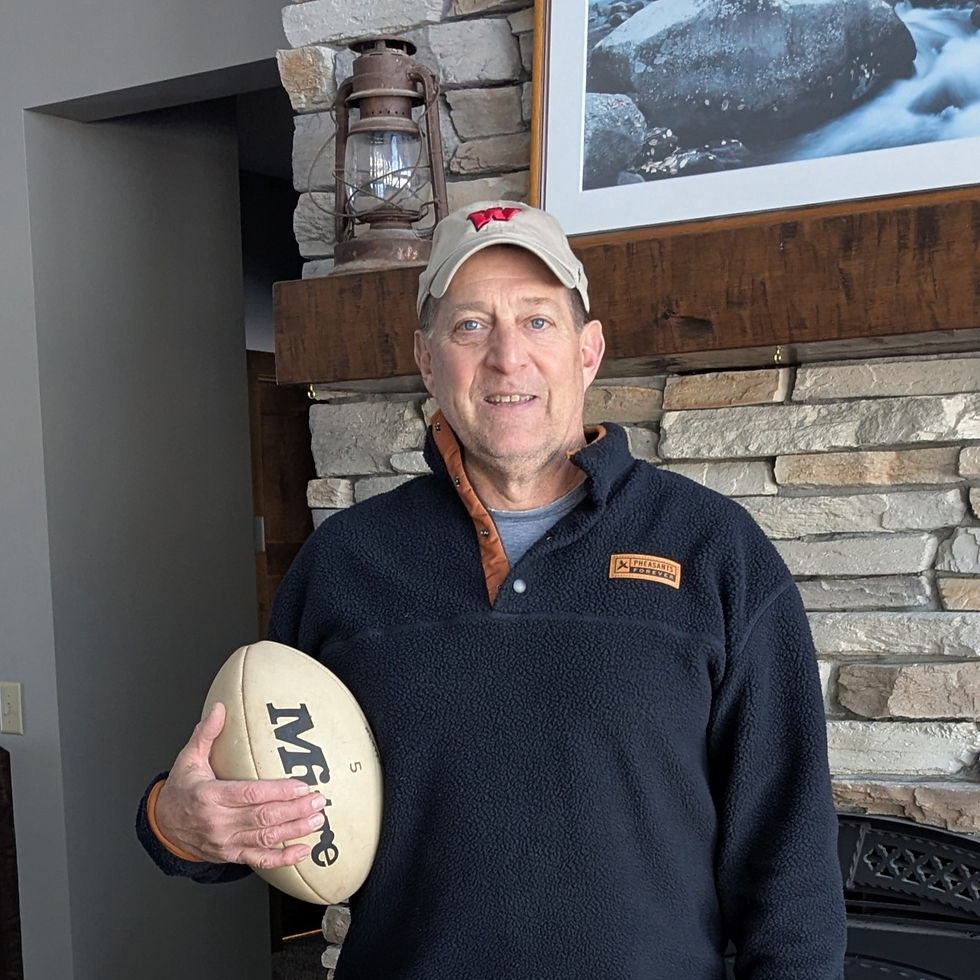
Although Coach Kurtis does not like being in the limelight, after several requests by this writer, he has finally agreed to be interviewed for this article!
Current Head Coach Kurtis Shepherd began playing rugby in his freshman year of high school. After football season, there was an expectation to participate in track and field, however, Kurtis was not inclined. His locker neighbor, Ben Stanley, asked if he would rather play rugby. Kurtis then joined the Marquette High Rugby Club.
After attending winter practices, Kurtis was thrown into the fire. There were only eighteen players on the team and Kurtis started at wing. The gameplay came natural and Kurtis was able to rely on his instincts to excel as a player. Kurtis noticed while playing other sports, there was a division in the ages of people. You were only friends with those in your same class. However, in rugby, regardless of age, everyone was friends. The inclusive nature of rugby helped Kurtis fall in love with the sport.
Throughout high school he was coached by Steve Gramling. He taught and stressed the fundamentals of rugby. Steve was a stoic coach choosing his words wisely and became a role model and inspiration for Kurtis. Steve’s coaching style heavily influenced how Kurtis coaches today.
Kurtis applied for UW-Madison, not thinking he would make the cut. Luckily for the club, Kurtis made it to UW and found the rugby club. He was coached by Skip Heffernan, Ross Hopkins, Lisa Roehl, Phil Callen, Paul “Guido” Stroede, Nic Tyson, and Adam “Moony” Kuen . Each became another role model that helped shape Kurtis’s life. They helped to build, refine, and perfect fundamental skills learned while being coached by Steve Gramling.
Kurtis began playing for UW in 2009. At that point the Big Ten Rugby Union did not exist, however, there was a tournament each fall where the “Big Ten” teams would gather, play several matches and crown a winner. At the tournament in 2009, Kurtis played well and proved himself. He would be part of the starting lineup for every game after that. Kurtis would play primarily wing and outside center. Additionally, he was a field manager, back selector, and captain. Kurtis always held some sort of leadership position on and off the field throughout his career at UW.
In 2012, the Big Ten Rugby Union was founded with an inaugural Big Ten Seven’s Tournament. At that time the teams were: Wisconsin, Nebraska, Indiana, Minnesota, Iowa, Ohio State, Michigan, Michigan State, and Purdue. Additionally, Penn State joined the Big Ten for the 7’s season. The club won the first and second Big Ten Seven’s seasons in 2012 and 2013.Both times Wisconsin beat Penn State in the finals! In 2013, Kurtis was captain. Also in that year was the first true Big Ten Fifteen’s Season. The team would win the first year in 2013, and, in a heartbreaking loss, would place second in 2014.
Kurtis was part of a class of very good players. In 2009 the freshman class boasted nearly a dozen players who already had rugby experience. Additionally, the class above them had a core group of experienced players. In his time he played with multiple UW Hall of Fame inductees: Garett Donath, Andrew Hanske, Joel Coen, Dan Gaenslen, Matoko Nouhdehou and others. Throughout Kurtis’ time with UW, the club was in an era of success winning every conference game and rarely losing in tournament play. In both 2013 and 2014 the club went to CRC’s in Philadelphia making the quarterfinals each year.
After college, Kurtis was set to play for a local men’s club in New Zealand. Unfortunately, concussions caught up to him and Kurtis made the difficult decision to forgo playing rugby in the interest of long term health. After hearing about this development, Nic Tyson and Skip Heffernan asked Kurtis to be an assistant coach at UW.
At first, Kurtis was wary of taking up a coaching position. He would be coaching a team he had just finished playing for. However, he took up the mantle and quickly learned the ins and outs of coaching college rugby. He says, “coaching is all about preparation, organization, and diligence”. Kurtis was a coach when the club won the Big Ten title in 2015, meaning each championship in the Big Ten era Kurtis had a hand in.
Kurtis would step back from coaching when life called him back to Milwaukee, however, that would not last. In 2018, after another Big Ten title for the club, Kurtis was convinced by Skip to come back as an assistant coach with an eye to taking over the program. At that point Scooter (Scott Adlington) was head coach. In 2019, after Scooter left the program to return to Australia, the title of head coach was thrust upon Kurtis.
There was a turnover in senior leadership following the 2018 season, and through growing pains the club would finish 5th in 2019. However, trouble loomed on the horizon.
The club was torpedoed by COVID. One of the key elements to every team is the experience and leadership of the upper classman. A coach needs to be able to focus on promoting the fundamentals and developing a game strategy. However, post COVID Kurtis was faced with the dilemma of little senior leadership and several classes of players who were underdeveloped. (The writer of this article was one of those underdeveloped players).
Kurtis was faced with the problem of redeveloping the club. He turned to his role models for inspiration. He worked to give each player what he had, a good competitive side with a role model for a coach. He wanted the club to remain competitive, know how to have fun, and to enjoy the soul of rugby.
The success of the club is self-evident of Kurtis’ development of these goals. In 2021, the
team placed 7th. In 2022 and 2023, the team placed 5th. In 2024, the team placed 4th, and just a few weeks ago in a nailbiter plate final the team placed 3rd in the Big Ten. There is now a solid core of senior leadership, and the success rate of the team shows the diligence and preparation that the players have made under the direction of Kurtis.
In lieu of asking for advice, I asked Kurtis in his interview for this article: what comes next? Now that the team has a strong base, it becomes a numbers game. The level of play is right where we need to be to be competitive in the Big Ten, but there is an aspect still missing. When playing against Indiana and Notre Dame (the teams who placed first and second this year), Kurtis noted that their sidelines were far fuller than Wisconsin’s. These programs boast 60+ players while UW has averaged 30-40 in the past few years. It will take a concerted effort to increase our numbers, and the thing Wisconsin lacks that these other programs do not is a full-time head coach. It is difficult for someone to manage a larger program while also working a full-time job outside of rugby. A head coach can dedicate time to implementing recruiting strategies on and off campus, and can better coordinate the team in general. While player leadership will always be at the center of the club, a full-time head coach will help guide the team and maintain consistency year to year. Big things are in the future for UW, and each step we take in the right direction, the higher the chances Wisconsin is once again established as the dominant team in the Big Ten like it was in 2013 and 2014.
Thank you, Kurtis, for your dedication to Wisconsin Rugby. Under your leadership we have grown and bounced back from harsh circumstances. Thank you for taking time for this article, and we look forward to seeing the continued development of the program!


Comments